facebook-tag-for-gem-equipments

Achieving Quality Compressed Air: Essential Components for an Efficient Air-Drying System

QUALITY AIR PNEUROP

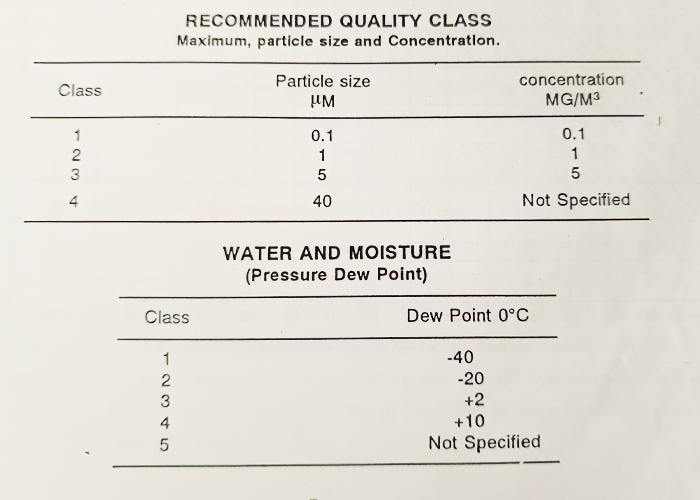
      Quality Air Pneurop - which is the authority for establishing standard for compressed air equipment in Europe have made some recommendation for quality standards of Compressed air. It classifies 3 main contaminations in air.
They are: * Solid Contaminants; * Water and Moisture; * Oil particles and vapour.

Recommended Quality class
Compressed Air Dryer System

      While the dryer is the heart of the compressed-air drying system, a number of accessory components are needed for the dryer to function correctly. There are also auxiliary items that improve the operation or the maintenance of a dryer, or both, to such a degree that the process becomes simple and routine. Following are a number of the most frequently used components.

Compressor

The compressor is used to increase the pressure of the air to that desired in the system. Numerous types with differing pressure ratings are available.

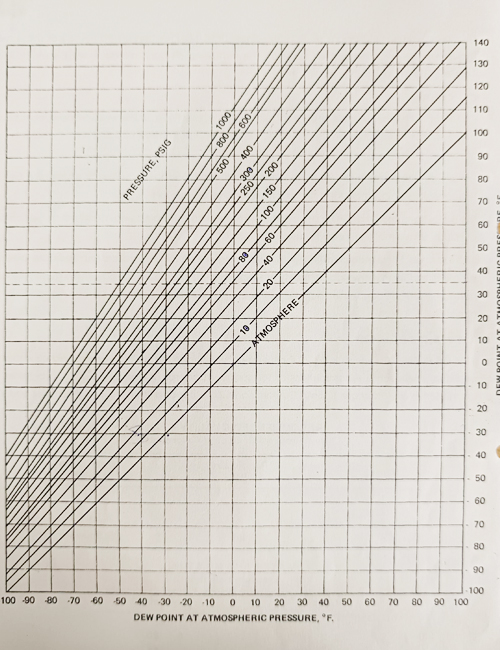
Dew point at Atmospheric Pressure

Today market has a wide range of Compressor which has its own advantages, disadvantages which has to be seen from different view point like initial cost, operating efficiency, maintenance and quality of air determined.
      Reciprocating Compressor are the one which we widely used. These are built in a wide range of model from a few HP to very large size. Recips themselves differ in their construction like vertical, Balanced oppose, Water cooled/air cooled, single stage/multi stage and so on.
The new entrant to the Air compressor in the screw compressor. These use two helically fluted screw which mesh and compresses air while they run. These have certain advantage in maintenance and operating cost. Other types of compressors are available like vane compressor, Centrifugal compressor. Of which centrifugal slowing being introduced.

OIL FREE COMPRESSOR

      Since the lubricating oil used to lubricate the compressors contributes to the bulk of the oil carry over in the compressed air, compressor manufacturers have come out with Oil Free Compressor. Oil free Reciprocating compressor do not use oil in the crankcase; they have Teflon rings which are self-lubricating. These are quite popular and available in India. The latest trend is the so-called Dry Screw.
Normally screw compressor are flood lubricated i.e., the lubricating oil is injected into the compressor chamber and air oil mixture comes out of the compressor block. The oil is separated from air by means of oil separator filter and air is sent to the outlet of the compressor. The dry screw compressor does not get in touch with oil at all and the compressed air is oil free.

      To obtain the advantages of Lubricated compressor like cost and maintenance over non-lubricated compressors, people have started using the concept of removing oil from standard lubricating compressor using high efficiency oil removing filters in the airline.
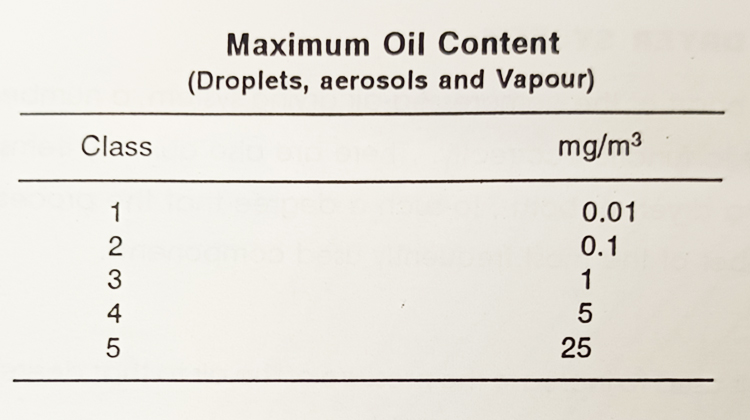
      This oil removing filter uses high efficiency micro fibre paper media made out of Borosilicate other suitable material which uses the principle of coalescing technique. These filters which are available can filter oil content as low as 0.01 mg/m3 also. These filters should be protected by providing a pre- filter for removing the dirt and dust particles.

Maximum Oil Content
Problems Caused by Water in Compressed Air

      Any one responsible for maintaining and operating plant compressed-air systems will be aware of problems caused by water in the air system. The problems are very apparent to those who operate pneumatic tools, rock drills, automatic, air-powered machines, sandblasting equipment, pneumatic logic devices and controls, air gaging, and paint spray equipment.

The principal problems might be summarized as follows:

  • Washing away required lubricants

  • Causing rust and scale to form within pipelines

  • Increased wear and maintenance of pneumatic devices

  • Sluggish and inconsistent operation of air valves and cylinders

  • Malfunction and high maintenance of control instruments and air logic devices

  • Product spoilage by spotting in paint and other types of spraying

  • Rusting of parts that have been sandblasted

  • Freezing in exposed lines during cold weather

  • Further condensation and possible freezing of moisture at the exhaust whenever air devices are rapidly exhausted


In the last case, some rock drills exhibit a 70°F (21°C) drop in temperature from inlet to exhaust. Most portable pneumatic tools have a considerably smaller temperature drop, but the problem can exist.
The increased use of control systems and automatic machinery has made these problems more serious and has caused increased awareness of the need for better-quality compressed air. Air-drying equipment is now a standard part of any well-designed compressed-air system.


AFTER COOLER

      Compressed air dryers are selected based on required flow, pressure, temperature, and dew point. Any variation in these parameters can strongly affect drying efficiency. Normally, compressed air exiting a compressor reaches 180–350°F (82–177°C) depending on compressor type and cooling method. At these temperatures, the air contains high moisture content, so installing an aftercooler before the dryer is essential.
      An aftercooler can remove 50%–75% of water vapor, depending on compressor intake conditions and cooler type. As the air temperature drops, moisture condenses and can be drained as liquid, reducing the load on the dryer and improving performance.
      Aftercoolers are available in air-cooled or water-cooled models, in both horizontal and vertical designs. Smaller air-cooled models can be mounted on tank compressors and use airflow from the compressor’s flywheel, while larger versions work using ambient air without requiring extra electricity or water.

Separators

      A number of different types of separators are available to remove the condensed water from the air stream. The most common type uses the centrifugal principle, which drops out most of the liquid to a drain or sump area. The moisture is then periodically discharged by a manually or automatically opened drain valve.

Drain Valves And Moisture Traps

      There are many different types of manual and mechanical traps and drains. Although not the same, traps and drains do enable accumulated liquids to be held for draining from receivers, coolers, driers, drop legs, and the like. The manual units range from a simple petcock to a ball, gate, or globe valve. The simplest type of mechanical trap consists of a ball-float arrangement that activates when rising water reaches a preset level.
No power is required to open this type. The least complicated power-activated drain is solenoid type that is energized by a timer signal). The solenoid plunger is then raised and the fluid is dumped, Electric- motor-driven units are available with solid-state controls to program the time intervals between opening and also the duration of the open cycle. Finally, there are pneumatically activated drains that have the interval between openings and the duration of the opening timed by air logic controls.

Filters

      Coalescing and particulate filters are essential components used with compressed air dryers to ensure high-quality clean air. The dryer manufacturer’s recommended filtration setup should always be followed for best performance. A typical heatless dryer system includes inlet and outlet filters to remove contaminants before and after the drying process.
A coalescing filter removes oil and water aerosols by combining fine droplets into larger ones that can be separated and drained. A particulate filter removes solid impurities such as dirt, scale, rust and dust that may enter downstream of the compressor and dryer. Additional filters are also available to eliminate vapors and odors when required.
High-performance compressed air filters use multi-layer micro-fiber media to separate contaminants as small as 0.01 micron. Three major types of filters are typically used:

  • General Purpose Pre-Filter – 85% efficiency, 5-micron particle removal, used as a coarse pre-filter.

  • High-Performance Micro Oil Removal Filter – 99.99% efficiency, 1-micron particle removal, oil removal up to 0.5 PPM.

  • High-Performance Sub-Micro Oil Removal Filter – 99.9999% efficiency, 0.01-micron removal, oil removal up to 0.01 PPM, ensuring completely oil-free air.

These filters ensure dust-free, moisture-free, and oil-free compressed air for sensitive industrial applications.

Receivers

      Air receivers act as storage reservoirs within a compressed air system, helping stabilize air supply and improve system performance. Depending on installation location—before or after the dryer—they offer different operational advantages.
When installed upstream (before the dryer), the receiver absorbs compressor pulsations and acts as an additional separator, allowing remaining moisture, oil, and solid contaminants to settle out. It also enables separate discharge lines where only part of the compressed air supply requires drying.
      When placed downstream (after the dryer), the receiver ensures that airflow through the dryer stays within rated capacity and prevents issues such as liquid carryover, desiccant damage, or high dew-point levels. In this configuration, dry air is stored for peak demand, and temperature fluctuations during heat-reactivated dryer cycles are stabilized by the stored cool dry air.
For heat-of-compression dryers, the receiver must be installed after the dryer. Regardless of location, a properly sized receiver enhances system efficiency, reliability, and air quality.

About Us

Gem Equipments entered the engineering and fabrication industry in 1984. We specialise in design, engineering and fabrication of Cooling Towers, Compressed Air Dryers, Industrial Chillers and Compressed Air Treatment Accessories.

Our Location

Gem Equipments Private Limited
S.F. No.103, Avinashi Road, Arasur,
Coimbatore - 641 407,
Tamil Nadu , India

All Rights Reserved ©2020 Gem Equipments Private Limited

Gem Equipments entered the engineering and fabrication industry in 1984. We specialise in design, engineering and fabrication of Cooling Towers, Compressed Air Dryers, Wall Mounting Compressed air dryers, High Pressure Compressed air dryers, All Aluminium Compressed air dryers, Copper Coil Compressed air dryers, Dual Frequency Compressed air dryers, General Purpose Compressed air dryers, Logic Controller Compressed air dryers, Energy Saving Digital Compressed air dryers, Series Heatless Compressed air dryers, Desiccant Compressed air dryers, Bottle Type Cooling Tower, Adiabatic Cooling Towers, Cross Flow Cooling Tower, Compressed Air Receiver, Compressed Air Filters, Industrial Chillers and Compressed Air Treatment Accessories. A compressed air dryers is a device designed to remove moisture from compressed air. This compressed air dryers is essential in various industrial applications to ensure the efficiency and longevity of equipment.The compressed air dryers works by reducing the dew point of the air, preventing condensation and corrosion in the system. The design of a compressed air dryers varies depending on the type of compressed air dryers. Common types include refrigerated compressed air dryers, desiccant compressed air dryers, and membrane compressed air dryers. Each compressed air dryers type has its unique structure and method for removing moisture from the air. For instance, a refrigerated dryers cools the air to condense water vapor, while a desiccant compressed air dryers uses absorbent materials to remove moisture. The working principle of a compressed air dryers involves several stages to ensure efficient moisture removal. Initially, the air enters the the compressed air dryers and passes through a pre-filter to remove large particles. This pre-filter stage is crucial for protecting the compressed air dryers from potential damage caused by contaminants. The air then moves into the main drying chamber, where the compressed air dryers removes moisture through different mechanisms depending on the type of compressed air dryers. In a refrigerated compressed air dryers, the air is cooled to condense water vapor. The cooling process in the refrigerated compressed air dryers lowers the air temperature, causing the moisture to condense into liquid form. This condensed water is then drained out of the compressed air dryers, leaving the air dry. The dried air is then reheated to prevent condensation in the downstream piping. In a desiccant compressed air dryers, the air passes through desiccant material that absorbs moisture. The desiccant dryers uses materials such as silica gel or activated alumina to attract and hold water molecules. As the air flows through the desiccant compressed air dryers, the moisture is absorbed by the desiccant material, resulting in dry air. The desiccant compressed air dryers typically has a regeneration cycle to remove the absorbed moisture from the desiccant, ensuring continuous operation.In a membrane compressed air dryers, the air passes through a semi-permeable membrane that allows water vapor to pass through while retaining the dry air. The membrane dryers separates moisture from the air based on the difference in partial pressure across the membrane. This process in the membrane compressed air dryers ensures that only dry air reaches the end-use application. Applications: Compressed air dryers are used in various industries, including manufacturing, food processing, and pharmaceuticals. These dryers are crucial in applications where moisture-free air is essential for product quality and process efficiency. For example, in the food industry, a dryers ensures that air used in packaging is dry, preventing contamination. In the pharmaceutical industry, a dryers is used to maintain the integrity of sensitive products. Types of Compressed Air Dryers:Refrigerated compressed air Dryers: This compressed air dryers cools the air to condense and remove moisture.1. Desiccant compressed air Dryers: This compressed air dryers uses desiccant materials to absorb moisture from the air. 2. Membrane compressed air Dryers: This compressed air dryers uses a semi-permeable membrane to separate moisture from the air.3. Deliquescent compressed air Dryers: This compressed air dryers uses a hygroscopic substance to absorb moisture. 4. Heatless compressed air Dryers: This compressed air dryers uses a desiccant material that is regenerated without heat.5. Heated compressed air Dryers: This compressed air dryers uses heat to regenerate the desiccant material. A cooling tower is a crucial component in industrial production, designed to reduce heat from the plant and enhance production efficiency. Cooling towers vary in size, from small units to extremely large structures, and are used to cool industrial hot water. A cooling tower extracts heat from a building and releases it into the atmosphere, returning cooler water to the system. Industrial pipes transport the heated water to the cooling tower, where it is cooled and referred to as condenser water due to its role in absorbing heat from the chiller’s cooling coil. India’s rapid industrialization and production growth necessitate the construction of more factories, each requiring efficient cooling towers. Towertech stands out as a leading provider of cooling towers, known for their high-quality and reliable products. The interior features of cooling towers differ based on the cooling demands of a structure, with the size of the structure determining the cooling capacity required. WHAT IS A COOLING TOWER? A cooling tower removes heat generated during industrial processes by transferring it to the atmosphere using water. Most cooling towers operate by evaporating a small amount of water, which helps to cool the remaining water. A cooling tower is essentially a heat exchanger that brings air and water into close contact to reduce the water’s temperature. As a small quantity of water evaporates, the temperature of the remaining water decreases. Water plays a vital role in cooling towers, facilitating heat transfer from one place to another. Industries such as additive manufacturing, tool and die-cutting, chemicals, lasers, milling machines, and semiconductors all rely on cooling towers to keep equipment and products cool. HOW DOES A COOLING TOWER WORK? A cooling tower operates on the principle of heat exchange, utilizing thermodynamics to transfer heat from hot water to cooler water. During industrial manufacturing processes, significant amounts of heat are generated, necessitating cooling before the water can be reused. In a cooling tower, hot water from the industry is transported through pipes to the top of the tower, where it is sprayed through nozzles. As the hot water descends through the tower, it comes into contact with the air, cooling down in the process. The cooled water collects in a basin at the bottom of the tower and is then recirculated back to the industry for reuse. When water from the heated reservoir is pumped into the cooling tower, it is sprayed into tiny droplets, increasing the surface area and enhancing heat transfer through evaporation12. TYPES OF COOLING TOWERS Cooling towers are tailored to meet the specific requirements of different industries. Towertech offers a variety of cooling towers, each designed for optimal cooling efficiency. Here are some common types: o Cross flow Cooling tower o Modular cooling tower o Round shape cooling tower or Bottle Type Cooling Tower o Square Type Cooling Tower or Rectangular Type Cooling Tower OPERATIONS OF A COOLING TOWER The operation of a cooling tower involves several key components and processes: 1. Water Circulation: Hot water from the industrial process is pumped to the top of the cooling tower. 2. Water Distribution: The water is distributed evenly over the fill media using spray nozzles or distribution basins. 3. Air Flow: Air is drawn or pushed through the tower by fans (mechanical draft) or by natural convection (natural draft). 4. Heat Exchange: As water flows over the fill media, it comes into contact with the air, and a small portion evaporates, removing heat from the remaining water. 5. Cooling: The cooled water collects in the basin at the bottom of the tower. 6. Recirculation: The cooled water is pumped back to the industrial process to absorb more heat, repeating the cycle34. Bottle Type Cooling Tower / Round Cooling tower Overview: A bottle type cooling tower, also known as a round cooling tower, is a type of induced draft cooling tower. This cooling tower is designed to cool industrial process water by dissipating heat into the atmosphere. The cooling tower achieves this by allowing water to flow over fill media, which increases the surface area for heat exchange. Design and Structure: The bottle type cooling tower has a cylindrical shape, which helps in uniform air distribution. The cooling tower is equipped with a fan at the top that induces air flow through the tower. Water is sprayed from the top of the cooling tower and flows down over the fill media, where it comes into contact with the air. This process enhances the cooling efficiency of the cooling tower. Working Principle: The cooling tower operates on the principle of evaporative cooling. Warm water from the industrial process is pumped to the top of the cooling tower and distributed over the fill media. As the water flows down, it comes into contact with the air being drawn up by the fan. The air absorbs heat from the water, causing a portion of the water to evaporate. This evaporation removes heat from the remaining water, which is then collected at the bottom of the cooling tower and recirculated back into the industrial process. Advantages: • Efficient Cooling: The cylindrical design of the cooling tower ensures uniform air distribution, leading to efficient cooling. • Space-Saving: The compact design of the bottle type cooling tower makes it suitable for installations with limited space. • Low Maintenance: The simple design of the cooling tower reduces maintenance requirements. • Applications: Bottle type cooling towers are widely used in various industries, including power plants, chemical processing, and HVAC systems, where efficient cooling is essential for process optimization. Square Type Cooling Tower / Rectangular type cooling tower Overview: A square type cooling tower, also known as a rectangular cooling tower, is a type of induced draft cooling tower. This cooling tower is designed to cool industrial process water by dissipating heat into the atmosphere. The square shape allows for modular installation, making it suitable for larger cooling requirements. Design and Structure: The square type cooling tower features a rectangular design that facilitates easy installation and maintenance. The cooling tower is equipped with a fan at the top that induces air flow through the tower. Water is distributed evenly over the fill media through spray nozzles, enhancing the cooling efficiency of the cooling tower. Working Principle: The cooling tower operates on the principle of induced draft counter flow. Warm water from the industrial process is pumped to the top of the cooling tower and sprayed over the fill media. As the water flows down, it comes into contact with the air being drawn up by the fan. The air absorbs heat from the water, causing a portion of the water to evaporate. This evaporation removes heat from the remaining water, which is then collected at the bottom of the cooling tower and recirculated back into the industrial process1. Advantages: • Efficient Cooling: The rectangular design allows for uniform air distribution, leading to efficient cooling. • Modular Installation: The square shape makes it easy to install multiple units in parallel for larger cooling capacities. • Low Maintenance: The design of the cooling tower reduces maintenance requirements. Applications: Square type cooling towers are widely used in various industries, including power plants, chemical processing, and HVAC systems, where efficient cooling is essential for process optimization12. Crossflow Cooling Tower Overview: A crossflow cooling tower is a type of cooling tower where the air flows horizontally across the water stream. This cooling tower design allows for efficient heat transfer and is commonly used in various industrial applications. Design and Structure: In a crossflow cooling tower, the hot water from the industrial process is distributed over the fill media from the top. The air enters the cooling tower from the sides and moves horizontally across the falling water. This perpendicular interaction between air and water enhances the cooling efficiency of the cooling tower. Working Principle: The crossflow cooling tower operates on the principle of evaporative cooling. Warm water is pumped to the top of the cooling tower and distributed over the fill media. As the water flows down, it comes into contact with the air moving horizontally. The air absorbs heat from the water, causing a portion of the water to evaporate. This evaporation removes heat from the remaining water, which is then collected at the bottom of the cooling tower and recirculated back into the industrial process. Advantages: • Easy Maintenance: The design of the crossflow cooling tower allows for easy access to internal components, making maintenance simpler. • Energy Efficiency: Crossflow cooling towers generally consume less power compared to other types of cooling towers. • Uniform Air Distribution: The horizontal air flow ensures uniform distribution, leading to efficient cooling. Applications: Crossflow cooling towers are widely used in industries such as power generation, chemical processing, and HVAC systems, where efficient cooling is crucial for process optimization. The cooling tower’s design makes it suitable for various cooling tower applications, ensuring efficient cooling tower performance. The cooling tower’s ability to provide uniform air distribution enhances the cooling tower’s efficiency. Additionally, the cooling tower’s easy maintenance feature makes it a preferred choice for many industries. The cooling tower’s energy efficiency also contributes to its popularity. Overall, the crossflow cooling tower is an excellent choice for industries requiring efficient cooling tower solutions. Modular Cooling Tower Overview: A modular cooling tower is a type of cooling tower designed for flexibility and scalability. This cooling tower can be assembled in modules, allowing for easy expansion and maintenance. Modular cooling towers are commonly used in various industrial applications where efficient cooling tower performance is essential. Design and Structure: In a modular cooling tower, each module functions as an independent cooling tower unit. These modules can be connected to form a larger cooling tower system. The modular design allows for easy installation and customization based on the cooling requirements. The cooling tower modules are equipped with fill media, fans, and water distribution systems to ensure efficient cooling tower operation. Working Principle: The modular cooling tower operates on the principle of evaporative cooling. Warm water is pumped to the top of each cooling tower module and distributed over the fill media. As the water flows down, it comes into contact with the air moving through the cooling tower. The air absorbs heat from the water, causing a portion of the water to evaporate. This evaporation removes heat from the remaining water, which is then collected at the bottom of the cooling tower and recirculated back into the industrial process. Advantages: • Scalability: The modular design of the cooling tower allows for easy expansion by adding more modules. • Flexibility: Modular cooling towers can be customized to meet specific cooling requirements. • Easy Maintenance: Each cooling tower module can be serviced independently, reducing downtime. • Energy Efficiency: Modular cooling towers are designed to optimize energy consumption, making them cost-effective. Applications: Modular cooling towers are widely used in industries such as power generation, chemical processing, and HVAC systems, where efficient cooling tower performance is crucial. The modular design makes these cooling towers suitable for installations with varying cooling needs. The ability to add or remove cooling tower modules provides flexibility in managing cooling capacity. Additionally, the modular cooling tower’s design ensures uniform air distribution and efficient heat transfer. The cooling tower’s easy maintenance feature makes it a preferred choice for many industries. Overall, the modular cooling tower is an excellent solution for industries requiring adaptable and efficient cooling tower systems A dry cooling towers is a type of cooling towers that operates without the use of water for evaporative cooling. This cooling towers is designed to transfer excess heat from industrial processes to the atmosphere using air as the cooling medium. Dry cooling towers are ideal for applications where water conservation is critical. Design and Structure: The dry cooling towers features a closed-circuit design, where the working fluid (usually water or a water-glycol mixture) circulates through a heat exchanger. The heat exchanger in the dry cooling towers is equipped with extended fins to increase the surface area for heat transfer. Air is drawn through the dry cooling towers by fans, which can be either natural draft or mechanical draft, depending on the design. Working Principle: The working principle of a dry cooling towers involves transferring heat from the working fluid to the air. The hot fluid from the industrial process enters the dry cooling towers and flows through the heat exchanger. Air is drawn across the heat exchanger, absorbing heat from the fluid. This process in the dry cooling towers cools the fluid, which is then recirculated back into the industrial process. Unlike traditional cooling towers, a dry cooling towers does not rely on water evaporation, making it more efficient in water-scarce regions. Advantages: • Water Conservation: A dry cooling towers significantly reduces water consumption compared to wet cooling towers. • Low Maintenance: The closed-circuit design of the dry cooling towers minimizes the risk of contamination and scaling, reducing maintenance requirements. • Environmental Benefits: By eliminating water evaporation, the dry cooling towers reduces the risk of waterborne diseases and environmental impact. Applications: Dry cooling towers are widely used in industries such as power generation, chemical processing, and HVAC systems. These dry cooling towers are particularly beneficial in areas with limited water resources. The dry cooling towers’s design makes it suitable for applications where water conservation is a priority. Additionally, the dry cooling towers’s ability to operate efficiently in various environmental conditions makes it a versatile solution for industrial cooling needs. Types of Dry Cooling Towers: 1. Natural Draft Dry cooling towers: This dry cooling towers uses natural convection to draw air through the heat exchanger. 2. Mechanical Draft Dry cooling towers: This dry cooling towers uses fans to force air through the heat exchanger, enhancing cooling efficiency. 3. Indirect Dry cooling towers: This dry cooling towers combines a dry cooling towers with a steam condenser for power plant applications. 4. Hybrid Dry cooling towers: This dry cooling towers integrates both dry and wet cooling technologies to optimize performance. Maintenance Tips: • Regularly inspect the dry cooling towers for any signs of wear or damage. • Ensure the fans and heat exchangers in the dry cooling towers are clean and free from obstructions. • Monitor the performance of the dry cooling towers and address any issues promptly. • Schedule routine maintenance to keep the dry cooling towers operating at peak efficiency. A dry cooling towers is an essential component in many industrial processes, offering significant benefits in terms of water conservation and environmental impact. By using air as the cooling medium, the dry cooling towers provides an efficient and sustainable solution for industrial cooling needs. Whether using a natural draft, mechanical draft, or hybrid dry cooling towers, the advantages of a dry cooling towers are clear. Investing in a high-quality dry cooling towers can lead to improved efficiency, reduced maintenance, and long-term cost savings. The dry cooling towers’s design ensures optimal performance and reliability, making it a preferred choice for many industries. Overall, the dry cooling towers is a versatile and effective solution for various cooling requirements. Compressed Air Filter Manufacturers – High-Performance Filtration Solutions Gem Equipments is a leading compressed air filter manufacturer providing high-efficiency air filtration systems for industrial, pneumatic, and automotive applications. Our compressed air filters, air compressor filters, automotive air filters, industrial air filters, air filtration systems, and HVAC filters are designed to remove dust, oil, moisture, and contaminants, ensuring clean and dry air for air compressors, compressed air filtration systems, air dryers, and industrial air purification. We offer a wide range of moisture separators, oil-water separators, air compressor water filters, air compressor moisture traps, and pneumatic filters to enhance compressed air quality, extend equipment life, and improve energy efficiency. Our air filtration solutions are ideal for manufacturing, food processing, pharmaceuticals, automotive, aerospace, HVAC, and industrial air purification systems. With advanced compressed air filtration technology, our high-performance air filters help maintain optimal air quality, reduce maintenance costs, and improve system efficiency. Whether you need industrial air filters, compressor filtration systems, air compressor water separators, air line filters, or air filter dryers, our durable and cost-effective filtration products ensure reliable performance and maximum efficiency in various industrial and commercial applications. Advanced Compressed Air Filtration for Maximum Efficiency Compressed air contamination can lead to equipment damage, production downtime, and reduced efficiency, making high-quality compressed air filtration essential for various industries. Our air compressor filters, pneumatic filters, and industrial air filtration systems effectively remove moisture, oil, and particulate matter, ensuring a clean and dry air supply for HVAC systems, industrial air purification, and compressed air dryers. With a focus on high-performance air filters, we provide moisture separators, oil-water separators, air compressor water filters, and air dryer filters that optimize air compressor efficiency, reduce wear and tear, and enhance productivity. Comprehensive Range of Air Filters for Every Industry As a trusted air filtration manufacturer, we offer a wide range of compressed air filters, automotive air filters, air compressor moisture traps, pneumatic air filters, and air purification systems to meet diverse industry needs. Our industrial air filters, HVAC air filtration systems, and air compressor filtration solutions are designed for food processing, pharmaceuticals, manufacturing, aerospace, and automotive industries. Whether you require compressed air line filters, performance automotive air filters, or industrial air purifiers, our cost-effective and durable filtration solutions provide superior air quality, energy savings, and long-lasting performance. Reliable Air Filtration Solutions with Advanced Technology With years of expertise in air filtration technology, our compressed air filters, air compressor air filters, and HVAC filters are manufactured using cutting-edge technology and high-quality materials to ensure maximum efficiency and durability. Our pneumatic filters, moisture filters for air compressors, and industrial air filtration systems help maintain optimal air quality, prevent contamination, and extend equipment lifespan. Whether you need a compressed air filter price comparison, an air compressor water separator, or an air line filter for compressors, our high-performance air filtration solutions are tailored to provide clean, dry, and contaminant-free air for a wide range of industrial applications.